AI-Driven Pesticide Repurposing for Precision Agriculture: An Interpretable Framework Based on Event-Centric Knowledge Graphs
The sustainable intensification of agriculture is challenged by persistent crop diseases and the rapid evolution of pathogen resistance. Repurposing existing pesticides offers a strategic alternative to de novo discovery, but identifying viable new applications from sparse and heterogeneous registration data remains a significant hurdle. To address this, we propose the Prototype-Enhanced Heterogeneous Graph Transformer (PE-HGT), a novel and interpretable framework for AI-driven pesticide repurposing. PE-HGT constructs an event-centered knowledge graph that explicitly models the complete pesticide-crop-disease triad, preserving essential agronomic context. To mitigate extreme data sparsity and long-tail distributions inherent in agrochemical records, a dedicated prototype refinement module learns latent, semantically coherent prototypes (e.g., functional groups) and enhances representations of sparse entities through alignment with these robust clusters. Evaluated on a real-world pesticide registration dataset, PE-HGT outperforms state-of-the-art graph and knowledge graph models with an AUC of 97.24\%. Crucially, the framework exhibits ``agronomic intelligence'' in navigating data-sparse scenarios. In a case study on \textit{Stem Rot} in corn, PE-HGT successfully prioritizes \textit{Bacillus subtilis} as a high-potential candidate, despite the absence of historical records linking this specific agent to the disease. This recommendation validates the model's ability to infer mechanism-based compatibility by synthesizing fragmented evidence from the knowledge graph (e.g., crop safety patterns from corn leaf blight and cross-species pathogen efficacy from pepper wilt). This work demonstrates a robust approach to accelerating the discovery of scientifically sound repurposing candidates, identifying effective solutions that are overlooked in existing registration databases.
Architecture
To address the dual challenges of data sparsity and the need for interpretable predictions, we propose the Prototype-Enhanced Heterogeneous Graph Transformer (PE-HGT). First, a heterogeneous graph encoder captures contextual node representations by aggregating information from their multi-relational neighborhoods. Subsequently, the prototype refinement module condenses these representations into a set of interpretable prototype vectors and enhances entity embeddings through alignment with these prototypes. This step is crucial for denoising the representations of sparse entities and injecting semantic coherence into the model's latent space. Finally, the refined representations are used to score candidate triples. This architecture ensures that predictions are not only accurate but also ground in a learned, interpretable concept space that resonates with agronomic reasoning.
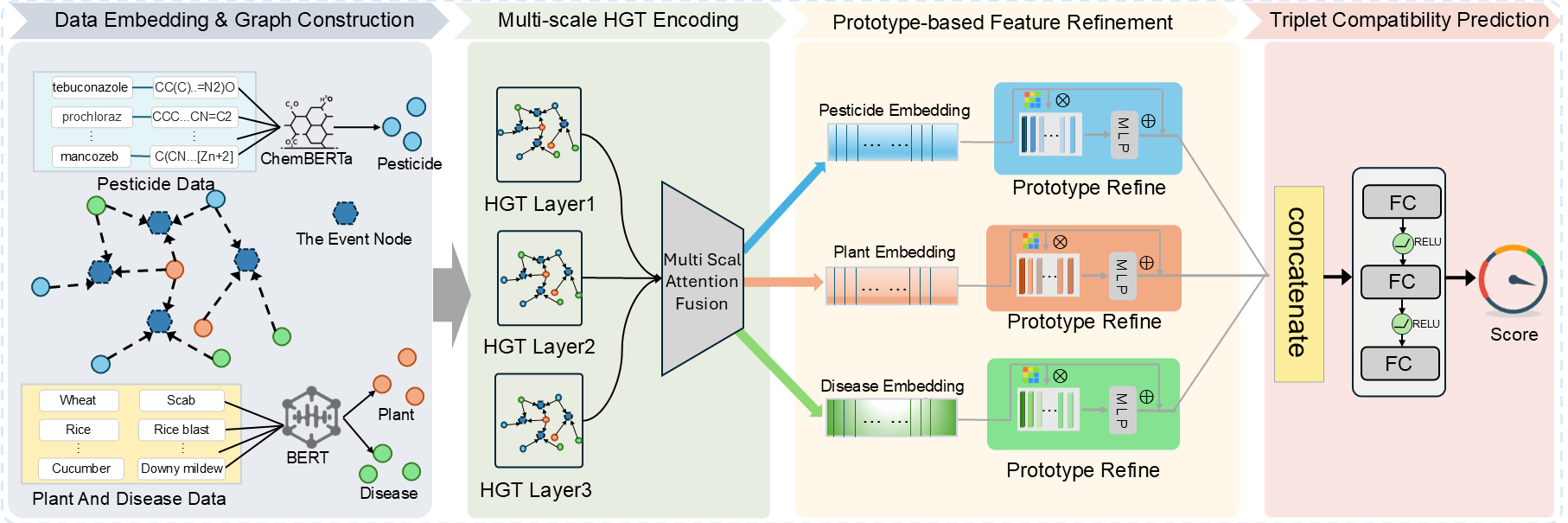
Overall architecture of the Prototype-Enhanced Heterogeneous Graph Transformer (PE-HGT) for pesticide repurposing. The model processes the heterogeneous graph through sequential stages of heterogeneous graph encoding, prototype refinement, and interaction scoring.