
AI-Driven Pesticide Repurposing for Precision Agriculture: An Interpretable Framework Based on Event-Centric Knowledge Graphs
Dependencies
- torch==2.1.2
- torchvision==0.16.2
- torchaudio==2.1.2
- torch-geometric==2.4.0
- torch-scatter==2.1.2
- torch-sparse==0.6.18
- pandas==2.1.3
- scikit-learn==1.3.2 # (sklearn)
- tqdm==4.66.1
- tensorboard==2.15.1
GitHub: https://github.com/GZU-SAMLab/PE-HGT
Data
The dataset for this study is derived from the official platform of the China Pesticide Information Network, which documents the approved uses of active ingredients against specific diseases on given crops. The study primarily focuses on single-agent fungicide formulations to ensure a clear mechanistic interpretation, a representative subset of insecticides and acaricides is strategically retained. To manage the complexity of these extensive records, the raw data are initially structured within a Neo4j graph database. Subsequently, for each identified active ingredient, the corresponding canonical Simplified Molecular Input Line Entry System (SMILES) string is retrieved from the PubChem database to provide a structured molecular representation.
The datasets and code of PE-HGT can be download from there.
Get Started
Predict
python main.py
Results
Overall Performance Comparison
To validate the effectiveness of the proposed PE-HGT framework, we conduct a rigorous comparative study against the established baselines. All models are trained and tested on identical data splits, with experiments repeated five times to ensure statistical reliability.
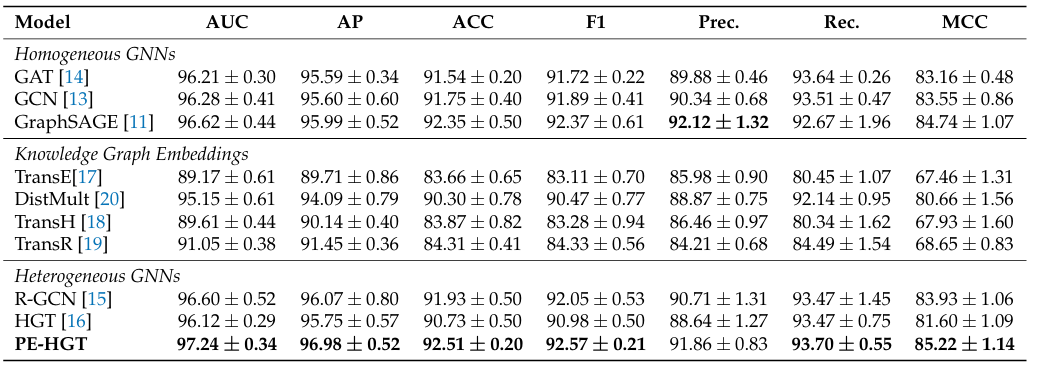
Overall performance comparison on the pesticide repurposing dataset. Values represent the mean $\pm$ standard deviation of five independent runs. The best results are highlighted in bold.
Interpretability Analysis of Learned Prototypes
To validate whether the PE-HGT framework captures meaningful agronomic semantics beyond simple structural similarities, we visualize the learned prototype space and examine the representative entities associated with each latent cluster.

Semantic interpretation of learned pesticide prototypes. The model autonomously groups entities into coherent clusters ($P_0$--$P_9$) that reflect specific chemical classes, application methods, and target pathogens.